Protected Content
Please enter the password to access this page
Fintech
Investosage
A Crowd Funding Platform Bridging MSMEs and Investors 30% Faster Through Transparent User Journeys.
Client
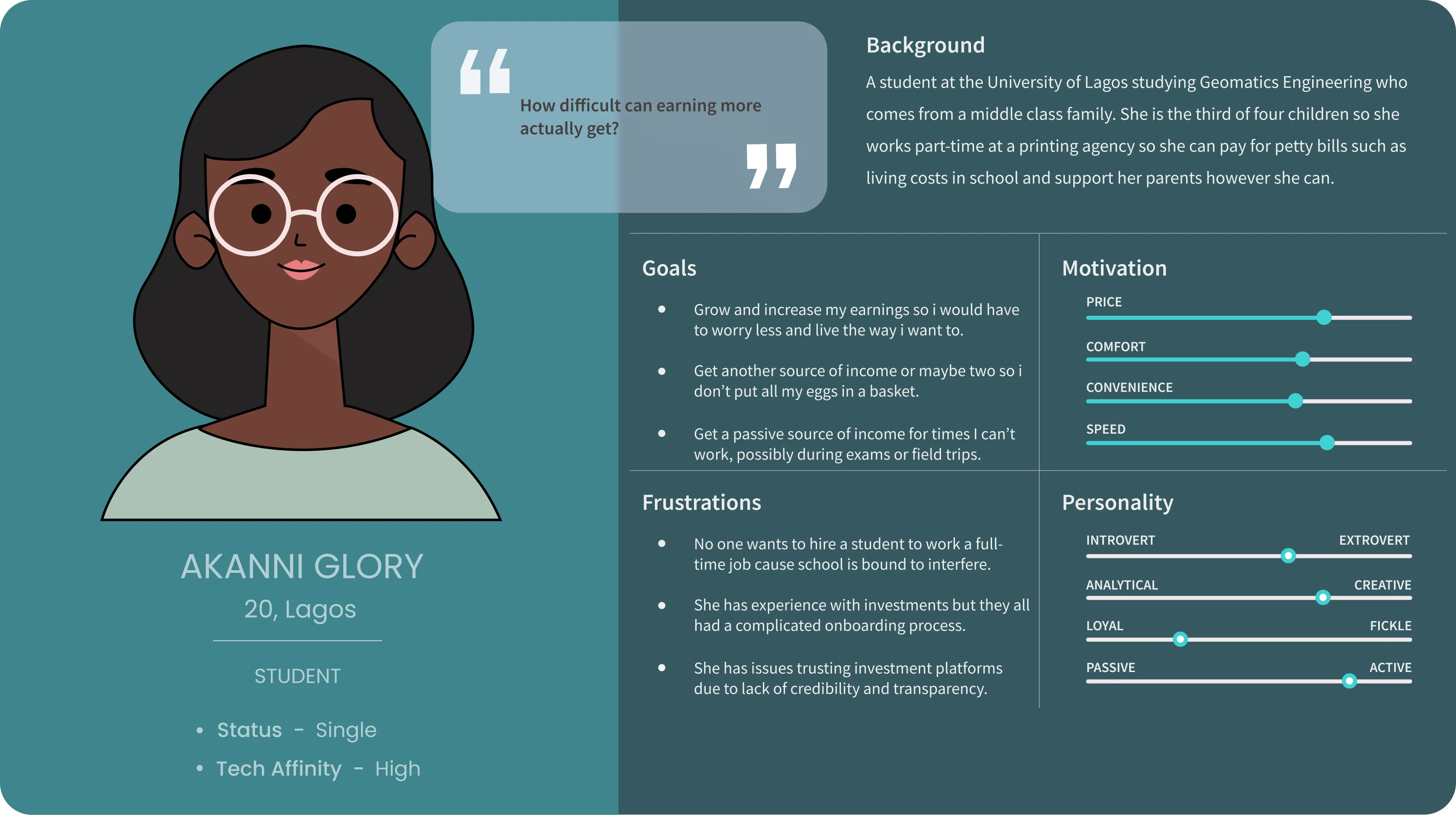
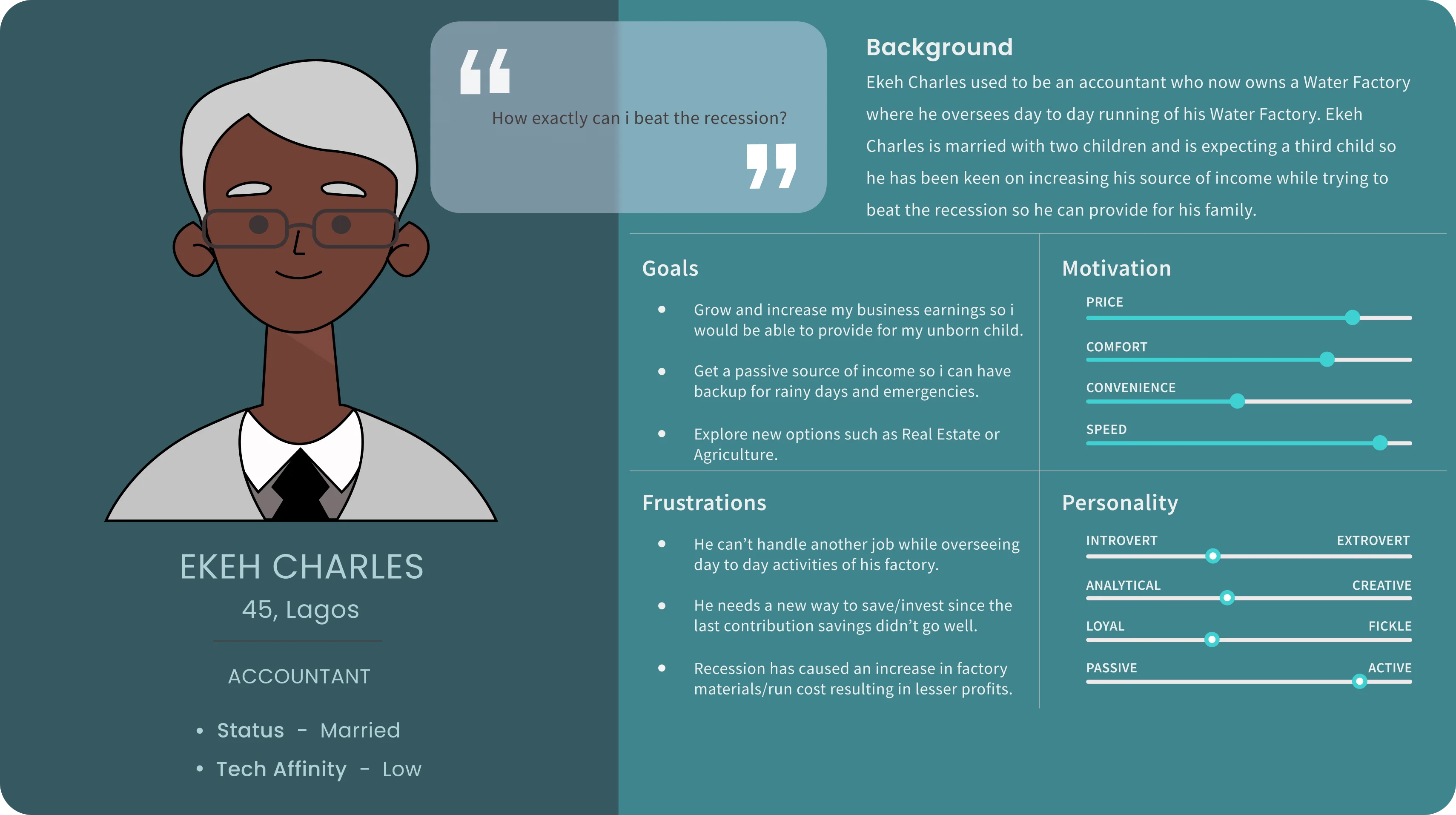
From this research user personas were created.
Role
Co Founder and Product Lead
Overview
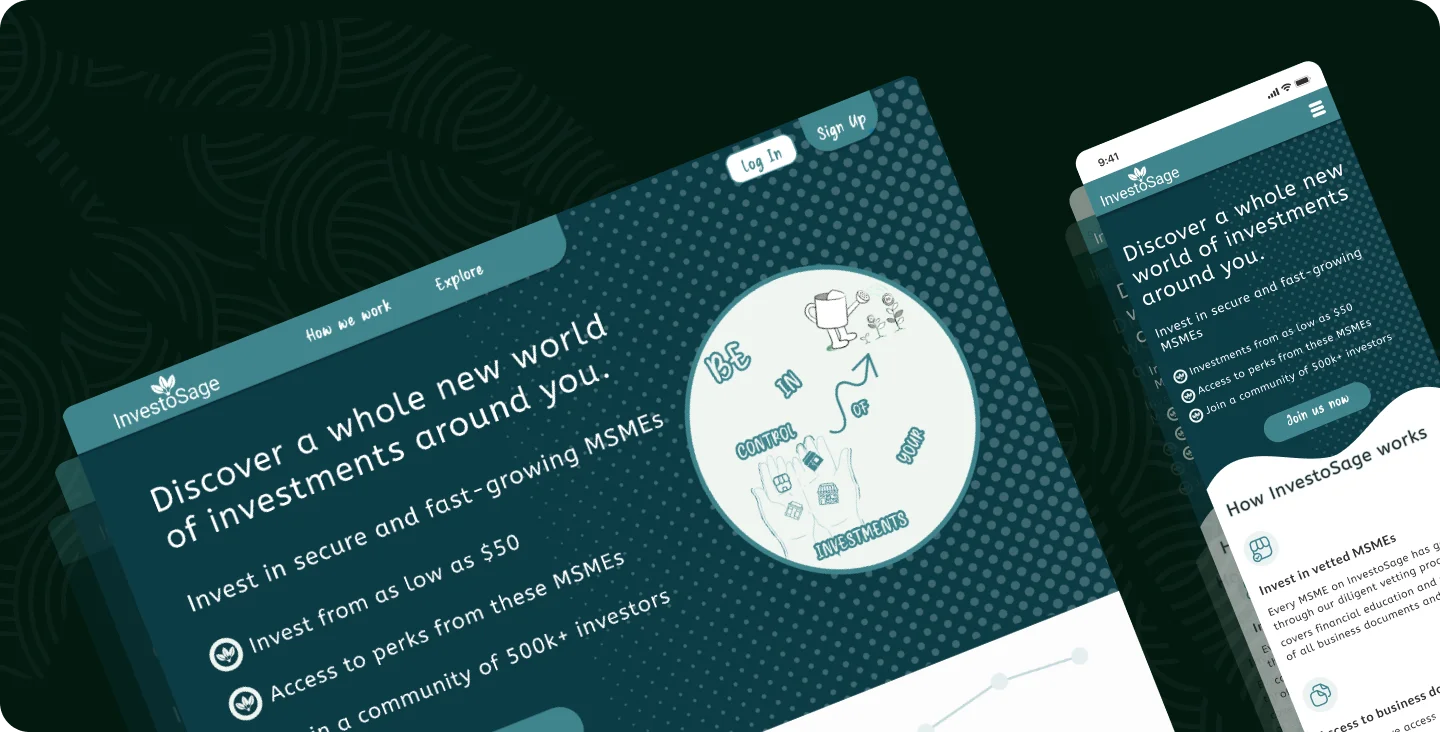
Investosage is a crowdfunding platform connecting formal and informal MSMEs aiming to expand or rebrand to individuals willing to invest to increase their earnings, creating investment opportun-ities and economic prosperity at close to zero risk. Investosage aims to bridge the $5.2 Trillion unmet financing needs annually by MSMEs globally. An ecosystem for both Investors and Entrepreneurs. This project was initiated and executed by the founding team. As a part of the original team and co-founder, I played an active role in the design and development of the product; creating the user interface, defining features, and ensuring a seamless user experience while coordinating efforts, setting milestones, and ensuring smooth progress throughout various development stages.
2021
13 Months
Fintech, Crowdfunding
5






The Problem
In Nigeria, Micro, Small, and Medium Enter-prises (MSMEs) are the lifeblood of the economy, contributing significantly to job creation and economic growth. However, the lack of finances and unmet financing needs pose substantial challenges to their sustain-ability and growth.
The Proposal
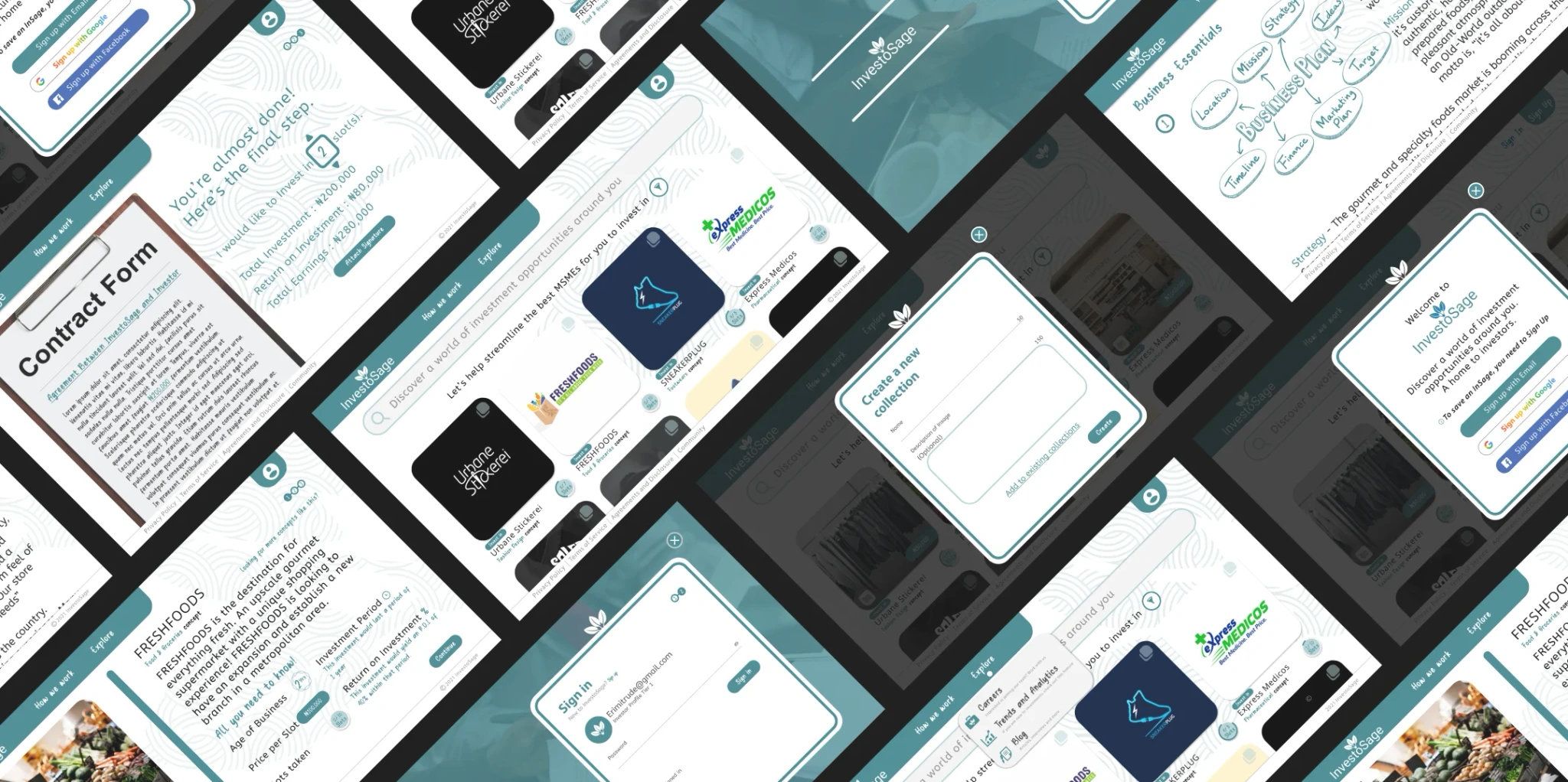
InvestoSage is a crowdfunding platform whose primary channels are a Web Application and a Mobile Application that connects the average Nigerian willing to invest in a seamless and secure way to formal and in-formal MSMEs that have been onboarded. InvestoSage takes a user centric approach to allows users perform all actions seamlessly.
Research & Discovery
After the project kickoff, our first priority was to define a comprehensive research strategy with focus on gaining insights into the target audience and customer segments, as well as identifying effective channels. We launched a multiple-choice online survey, quickly amassing 77 submissions.
Analyzing the data, we pinpointed some common pain points and discovered valuable insights into preferred channels and behaviors. These findings have significantly influenced our subsequent steps, ensuring a tailored approach that aligns precisely with our audience's needs and preferences.
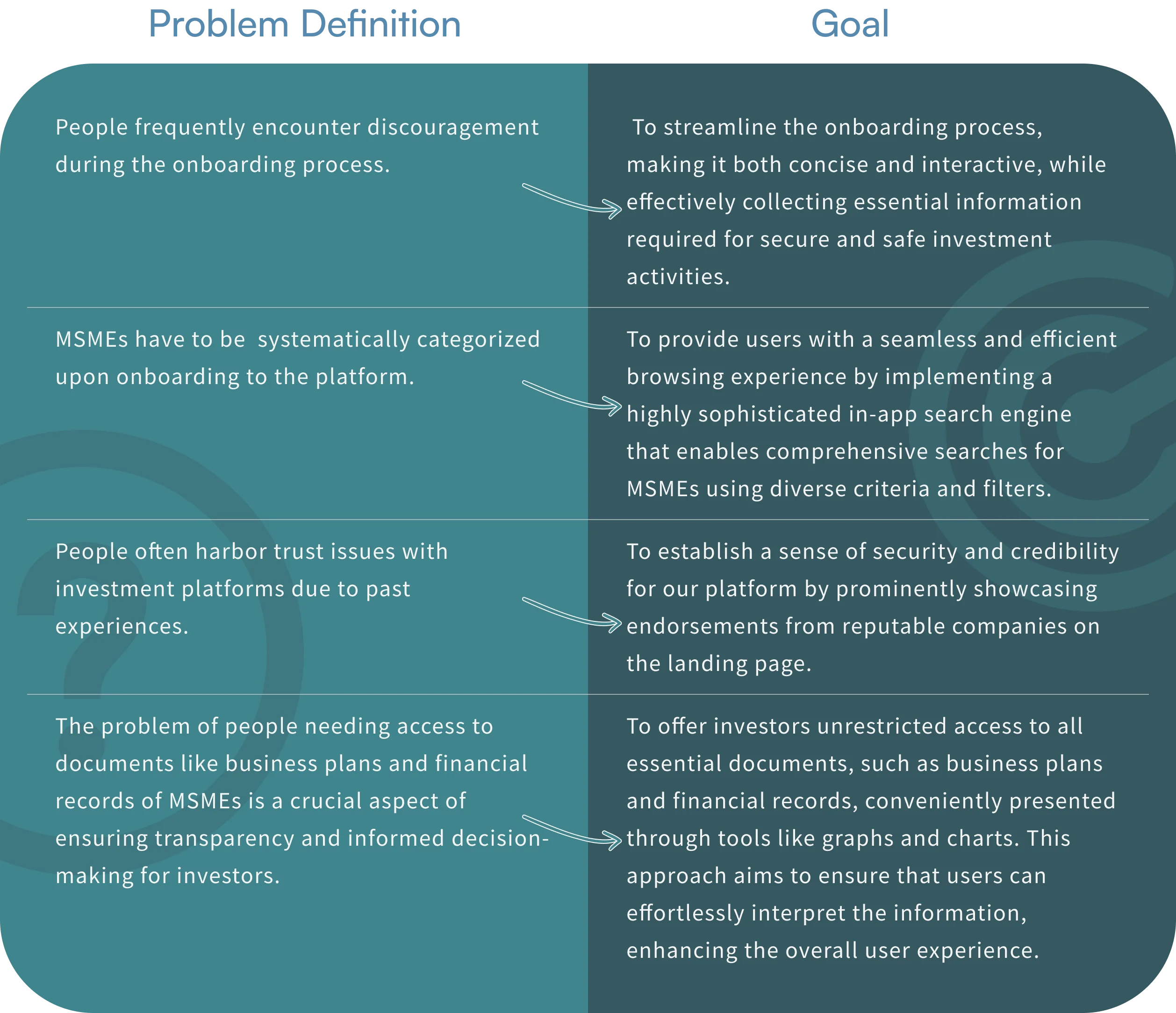
Research Insights
The customer segment consisted majorly of people within the ages of 18 - 65 and a larger percentage of informal MSMEs than formal MSMEs.
90% of users were actively seeking out investment opportunities to grow their income
55.8% of people were familiar with making investments in the past.
53.7% of users indicated that they preferred the MSMEs they want to invest in to be in Agriculture Sector.
Showcasing endorsements and partnerships with reputable organizations did give 59.1% of users a sense of security and credibility.
The preferred channel for 64% of users was the Web App.
These findings facilitated the prioritization of Web App design and development, while attentively addressing the needs of the target audience.
Click here to view survey answers
User Personas
From this research user personas were created.
A look at the Competition
To design a clear and trustworthy investment experience for first-time and everyday investors, I conducted a competitive analysis of similar investment and crowdfunding platforms. The goal was to understand the UX patterns people already trust, where users commonly experience overwhelm, and what best supports informed investment decisions.
I evaluated Wefunder, SeedInvest, Chaka, and RiseVest. Each of these platforms handles complex financial workflows, relies on user trust, and serves investors with varying levels of financial literacy. Instead of replicating these experiences, my objective was to understand the behavioural patterns behind them and design a more approachable, transparent model for InvestoSage.
| This is scrollable on mobile devices.
Category | Wefunder | SeedInvest | Chaka | Risevest | Opportunities |
|---|---|---|---|---|---|
Trust Signals | Heavy partner logos, testimonials | Strong regulatory messaging | Media mentions | Performance history | Make trust visible early in the user journey |
Onboarding | Simplified multi-step flow | Upfront heavy KYC | Light onboarding | Investor profile quiz | Reduce friction using progressive disclosure |
Investment Info | Dense, long-form | Structured into segments | Simple summaries | Visual-first | Blend structure with visual summaries and charts |
Documents | Many PDF downloads | Organized filings | Limited documents | Minimal access | Provide summaries and downloadable files |
Transparency | Basic portfolio view | Detailed breakdown | Minimal | Moderate | Prioritize clarity through clear returns and risk indicators |
Guidance | FAQs | Investor education | Minimal | Automated prompts | Integrate guidance directly into the decision-making flow |
Key UX Findings
Trust is built visually before anything else
Platforms with higher conversion place strong credibility markers at the top of the experience. These include partner brands, media mentions, regulatory cues, and social proof. This helped us anchor InvestoSage’s landing experience around endorsements and recognisable trust signals.
Dense financial information creates hesitation
The strongest platforms don’t try to make users read everything at once. They separate details into structured sections with short summaries before deeper content. They also reinforce information with charts, timelines, and simplified metrics. This guided how we presented MSME performance data and business plans.
Heavy onboarding early on causes drop-offs
Platforms with strict verification at the very beginning lose users quickly. Successful ones allow users to explore first, then verify later. This informed our approach to lightweight onboarding followed by more formal checks once intent is established.
Transparency around risk increases user confidence
Users respond better when risk isn’t hidden. Clear labels, repayment expectations, and explanations about potential downsides reduce uncertainty. This led us to include risk levels, repayment timelines, and contextual reminders before an investor commits.
Storytelling improves decision quality
People invest in stories as much as in numbers. Platforms that explain the “why” behind each opportunity create deeper engagement. For InvestoSage, we strengthened MSME profiles with narrative context: who they are, why they need funding, and the impact of investment.
How These Insights Shaped InvestoSage
Patterns from the competitive analysis directly influenced several design decisions.
Trust signals were placed at the top of the landing page to reassure new investors.
Investment information was structured into modular sections supported by visual summaries.
The onboarding sequence was redesigned with progressive disclosure to reduce friction.
Risk transparency was surfaced through clear labels, timelines, and short explanations.
MSME profiles combined metrics with storytelling to make opportunities more relatable.
These decisions were not aesthetic; they were behavioral. Each choice was made to reduce cognitive load, support decision-making, and build confidence in a high-stakes context.
MVP Features
At this stage of the project, our focus was intentionally narrow. We scoped the MVP to validate only the investor-facing experience, which was the clearest way to test demand, usability, and trust perception without building the full ecosystem.
Core Investor MVP Features
These were the only flows we designed and prototyped:
1. Opportunity Listing
A simple, scrollable catalog of MSMEs seeking funding. My goal was to help first-time investors quickly compare opportunities without needing financial expertise.
2. Opportunity Detail Page (Lightweight Version)
This contained only the essentials:
Business overview
Funding amount + goal progress
Repayment timeline
High-level financial documents (summary only, not interactive)
3. Investment CTA + Onboarding Flow
Users could begin the investment action, but were required to onboard first. This helped validate whether users intended to invest without needing to build the full payment infrastructure.
4. Early Portfolio Stub
Not a real dashboard — just a placeholder screen representing what users would see after investing. Its purpose was to test comprehension and expectations during usability sessions.
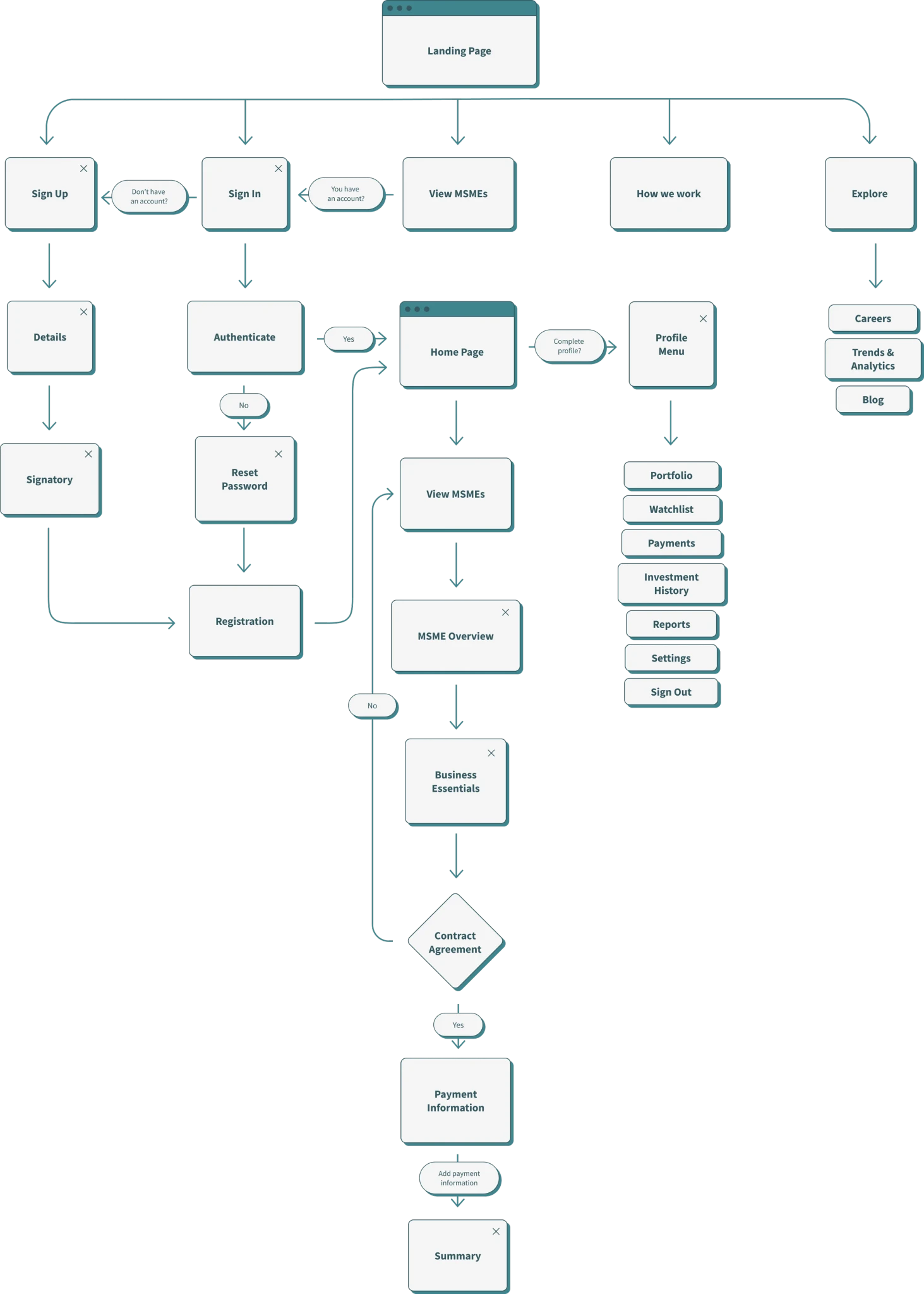
User Flow
Wireframes

Low Fidelity Wireframes
Style Guide



A look at the Competition
Research & Analysis: We conducted user interviews, surveys, and analyzed in-app analytics to understand the pain points and user needs. We also studied competitor apps and industry trends to gather insights
Information Architecture: Based on the research findings, we restructured the app's navigation and content, prioritizing features and information according to user needs.
Wireframing & Prototyping: We designed low-fidelity wireframes to visualize the new layout and navigation, iteratively refining them based on user feedback. Afterward, we built a high-fidelity, interactive prototype to test the design.
Usability Testing: We conducted usability tests with a diverse group of users to validate the design and identify areas for improvement. Based on the feedback, we made necessary adjustments to the design.
Visual Design & Style Guide: We developed a cohesive visual language, including color schemes, typography, and iconography, ensuring consistency throughout the app. We also created a style guide to maintain design consistency in future updates.

“ With our new visual branding and language in place, the new Shopify brand clearly captures the essence of our current and target customer base, our employees, and our values. ”
Tobias Lütke
CEO, Co-founder | Shopify
35%
Improved onboarding process
25%
Increase in user retention
84%
Increase in time spent on website


Conclusion
The StreamLine mobile banking app redesign successfully addressed the usability issues, resulting in a more intuitive and user-friendly experience. The improved UX/UI design led to increased user adoption, engagement, and satisfaction, demonstrating the value of a well-designed template for UX designers.